Monday, September 12, 2011
Question of the Week 34: Freelance
Monday, September 5, 2011
Question of the week 33: Hexadecimal
Hi and welcome to this week’s question of the week! This week I will cover the word hexadecimal, which I will include in the following question:
How do you count with hexadecimals?
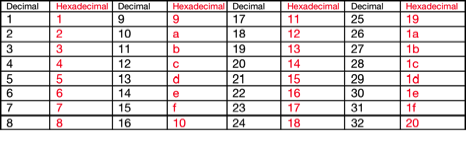
A hexadecimal is a numbering system that counts to 16. Whilst the decimal system counts from 1 to 10 before it resets (e.g. 1–10, 11–20, 21-30, 211-220), a hexadecimal system counts from 1 to 16 before resetting. However, since it is not possible to show more than 10 numbers before resetting (i.e. not possible due to the fact that the decimal system is used to portray hexadecimals), letters are used to fill the remaining 6 numbers before the integer ends. Thus, the last integer in a hexadecimal before the number resets ends with 0 (e.g. f à 10, 4f à 50), just as how it would in the decimal system (e.g. 9 à 10, 49 à 50). This table shows how hexadecimals are written up to the decimal number 32:

A simplified way of describing the decimal system is by calling it a base-10 system, which means that it contains 10 digits. The hexadecimal system on the other hand is a base-16 system, containing 16 digits.
But what use does it have if we are following and accustomed to the decimal system? Well, it is mainly used as a convenience for large numbers. For instance, instead of writing ‘255’ in the decimal system, you could write ‘FF’ in hexadecimal format (FF = 15x16 + 15). This is commonly used in computer codes (e.g. color map, memory addresses, HTML, etc).
In short: A hexadecimal is a numbering system that uses 16 digits as opposed to the decimal system (10 digits) that we are accustomed to today. This system is meant to make large numbers more convenient to read and implement, especially in computers.
If you have any questions or doubts, or would like to contribute, then please do not hesitate to leave a comment!
Monday, August 29, 2011
Question of the week 32: Fugitive
Hi and welcome to this week’s question of the week! This week, the word ‘fugitive’ will be covered in the following question:
How do fugitives get caught?
A fugitive is a person that is on the run from the government or the police, with the purpose of avoiding arrest. Individuals who have committed crimes such as corruption, drug dealing, and murder are most likely to become fugitives due to the severity of the crime and consequent penalty. Since individuals become fugitives when authorities cannot find them, various methods are required to find them. Here are five ways in which policemen can track down and catch fugitives:
- Use the location of bank transactions to trace the fugitive
- Use bounties (reward for capture) to encourage people to help find the fugitive
- Use family members to convince the fugitive to turn him/herself in
- Authorities collaborating with each other across regions/countries to share information on the fugitive
- Trace phone calls made by the fugitive
In short: A fugitive is a person that is on the run from the government or the police. Catching a fugitive may not be easy, but there are a number of methods to catch them. These include tracing bank transactions, bounties, using family members, having authorities collaborate, and tracing phone calls.
If you have any questions, doubts, or would like to contribute, then please do not hesitate to leave a comment!
Monday, August 22, 2011
Question of the week 31: Regime
Hi and welcome to this week’s question of the week! This week the word ‘regime’ will be covered in the following question:
Why do political regimes falter?
A political regime is a government that puts rules, regulations, norms, and laws for citizens of a country to abide. It is either elected through a country’s citizens, through force, or through a governmental procedure.
Here are some reasons why political regimes falter:
1) Citizen rebellion – When a government does not provide what its citizens want and maintains its power, riots or rebellions may occur. This is especially prevalent in countries with an autocratic regime. Violent behavior would then force the political regime to leave.
2) Pressure from other countries – When a political regime does not respect human rights, other countries and organizations may put pressure on that regime to either change their ways of running a country or risk facing a trade embargo or even a conflict. One example is the spread of Communism which capitalism tried to contain in the Vietnam War.
3) Government not keeping its promises – When a president or prime minister is elected, that individual will put in place his or her political regime. This includes a set of goals and promises that were said during the political campaign before election. However, when a government cannot meet its promises, the leader’s trust, reputation, and popularity begins to falter, thereby leading to new elections.
4) Corruption, bribery, or other legal issues – Sometimes the leader of a country has a personal agenda that is not to the interest of a country. Corruption and bribery not only wastes taxpayer money for personal gain, it also limits government investments in improving the country’s standards of living. A result of this would be that the leader does not get re-elected, gets impeached, or that the reputation of the whole political party would be lost.
In short: A political regime is the rules, regulations, norms, and laws that are set by a government. They can fail if there is a citizen uprising, if there is pressure from other countries to stop the regime, if the regime does not meet its expectations, or if legal issues plague the regime leader.
If you have any questions, then please do not hesitate to leave a comment!
Monday, August 15, 2011
Question of the week 30: Riots
Hi and welcome to this week’s ‘Question of the Week’! I hope that everybody has had or is having a nice summer vacation! However, as is with every holiday, it comes to an end. Nevertheless, the question of the week is back. This week, the word ‘Riot’ will be covered in the following question:
Do riots create more change than peaceful demonstrations and protests?
The term riot stands for a violent public uprising, where a group of people create civil unrest. Examples include, the riots that occurred in London that started from a peaceful protest against the police for shooting and killing a person, and the riots that broke out in the Middle-East to topple the dictatorial/autocratic regimes.
Demonstrations, protests, and riots all have a common goal, to create change. How they achieve these changes however are different. Both demonstrations and protests can be done peacefully. For instance, a group of people that protest against the country’s involvement in war can show this through creating signs and showing negative pictures in the hope that it would persuade decision makers to back out from the war. If the protest gains supporters over time, it would then force the government to make changes.
A riot on the other hand involves violent behavior in order to intimidate decision makers into making changes. This type of behavior has, for instance, led the Syrian leader Bashar al-Assad to create changes in the Syrian parliament and give in to some demands to retain peace in the country. Riots however do not have to create positive changes for the rioters. As is evident in the London riots, changes have been made by the British police force in how decision-making is done during such situations. All that the rioters gained from their actions were court appearances and penalties.
To say that riots create more change than peaceful demonstrations and protests is incorrect as both create them. However, riots have a more dramatic way in showing social frustration and thus leads to quicker changes. This usually comes at the expense of the rioters themselves as they end up doing more harm than good.
In short: Riots are violent public uprisings where people try to create change through wrecking havoc. Whilst riots may create change faster, it does not mean that it will create a positive change for them. Demonstrations and protests on the other hand are more peaceful, and allow other people to understand the changes. Through this way, it forces the government and/or decision makers to create changes since their reputation and popularity is put at stake.
If you have any questions, doubts, or would like to contribute, then please do not hesitate to leave a comment!
Sunday, July 10, 2011
Question of the week 29: Vociferous
Hi and welcome to this week’s question of the week! This week, the word ‘vociferous’ will be covered in the following question:
Name five man-made vociferous sounds
The term vociferous stands for something that is noisy or loud. For instance, a vociferous baby on an airplane was crying for her milk. Animals such as lions and bears become vociferous when threatened. Vociferous can also describe the noise of an explosion.
Here is a list of five man-made vociferous sounds:
1. Race cars – Race days such as F1, GP2, MotoGP, Nascar, and FIA GT, just to name a few, create a lot of sound pollution that affect nearby residential areas. As such, some circuits have a limited number of race days per year to minimize it.
2. Airplanes – Due to the sound pollution created by airplane engines, in some cities/countries airports are closed during the night.
3. Vuvuzela – A trumpet that has its history in South Africa. It was extensively used during the 2010 FIFA World Cup by fans supporting their countries. For the players and some spectators it was however also a nuisance.
4. Rock concerts – Music bands play loud music to involve the crowd and let them feel the full rhythm and beats of the songs. This however usually comes with a side effect, where it seems as if a bubble is covering your ears.
5. Alarms – Unlike the above-mentioned vociferous sounds, alarms are purposefully loud. They are meant to warn people of an emergency.
In short: The word vociferous stands for something or somebody being loud or noisy. This includes a baby crying on an airplane, or a car making a screeching sound after hitting the brakes very hard. Five man-made vociferous sounds include race cars, airplanes, vuvuzelas from the world cup, rock concerts, and alarms.
If you have any questions, suggestions, or examples, then please do not hesitate to leave a comment!
Sunday, July 3, 2011
Question of the week 28: Omnipresent
Hi and welcome to this week’s question of the week! For this week, the word ‘omnipresent’ will be covered in the following question:
Which mode of transportation carries the lowest omnipresent risk of fatality?
The term omnipresent stands for a danger or problem that is present at all times, such as a disaster that can occur at any time, a prison where criminals fighting each other is omnipresent, or the noise pollution from living close to an airport.
The modes of transportation are air, land, and water. For simplicity purposes, air transport will cover airplane travel, land transport will cover travel via cars and trains, and water transport will cover boat travel. The following list shows the number of fatalities per billion km, journeys, or hours traveled for each of the 4 forms of transportation mentioned:
| | Fatalities per billion KM | Fatalities per billion journeys | Fatalities per billion hours |
| Airplanes | 0.05 | 117 | 30.8 |
| Cars | 3.1 | 40 | 130 |
| Boats | 2.6 | 90 | 50 |
| Trains | 0.6 | 20 | 30 |
(source: http://www.numberwatch.co.uk/risks_of_travel.htm, originally from an article by Roger Ford)
Depending on how one looks at the statistics, airplane travel can carry the lowest omnipresent risk of injury. 0.05 people are killed due to an airplane accident over a span of one billion kilometers. However, when looking at it from the number of journeys and number of hours perspective, trains carry the lowest omnipresent risk.
It must be noted that whilst the media portrays the fact that airplane travel is the safest mode of transportation, it is really difficult to find factual and statistical information on this as it is not public knowledge. As such, the data used in this article represents what was attainable at the time of writing this article.
In short: Omnipresent stands for a danger or problem that is present at all times. Examples include the risk of a flat tyre, or the risk of a natural disaster, as both could happen anytime. Depending on how one interprets data, airplanes and trains can be seen as having the least omnipresent risk of fatality.
If you have any other thoughts or ideas, then please do not hesitate to leave a comment!