Showing posts with label edit-your-work blog. Show all posts

Monday, November 7, 2011

Question of the week 39: Simile


I hope that you had a nice Halloween and/or Guy Fawkes celebration! Now it’s time for another ‘Question of the Week’. This week, the word Simile is covered in the following question:

What is the purpose of similes?

The term simile is used when making a comparison. The words ‘like’ or ‘as’ need to be used in a sentence in order to create this simile. For instance, the sun is as big as 1,300,000 earths. Fireworks sound like cannon and gunfire. A number of expressions use similes, such as: ‘feels like heaven’, ‘flow like a butterfly; sting like a bee’, ‘as white as snow’.

Since similes are used for comparisons, they can be used in different contexts. One way is to establish a comparison so that it is easier to understand. This can be seen when comparing the imperial measurement system with the metric system. 1 inch is equivalent to, or is like, 2.54 centimeters.

Another One form of simile may involve the senses, such as herbal tea smelling like a flower garden. It would immediately remind you of something that you have smelled in the past. Something that is soft and spongy may have the simile of it feeling like gelatin.

Similes can also be used to express emotion. He was as angry as the Hulk. She was as happy as can be. This is especially used in storytelling where the listener did not see any of the emotions and interactions.

There are also other ways of using similes, such as to compliment a person, to crack a joke, to vent off anger or stress, to rate, etc. One thing that all these contexts have in common however is the fact that there is always a comparison to something that sparks a memory. Thus the purpose of a simile is to make you remember an event in order to make sense of what was being compared.

In short: A simile is a comparison, which utilizes the word ‘like’ or ‘as’ in a sentence. The purpose of a simile is to spark a memory in order to better understand what was being compared.

If you want to contribute to this post then please do not hesitate to leave a comment!

Monday, October 31, 2011

Question of the week 38: Halloween


Hi everybody and welcome to another question of the week! This week the word Halloween will be covered in the following question:

What is the story behind Halloween? How did it spread?

Halloween is an event that is held yearly on the 31st of October. Trick or treating is one big activity done that day where kids usually ask neighbors whether they would like to give a treat (candy) or be tricked into something scary. It is also a day for people to wear scary costumes, decorate their house with pumpkins carved with a scary face, and behave in strange ways to scare others.

There are a number of stories that tell the beginnings of Halloween. One of these stories goes as follows:

People have been making jack-o'-lanterns at Halloween for centuries. The practice originated from an Irish myth about a man nicknamed "Stingy Jack." According to the story, Stingy Jack invited the Devil to have a drink with him. True to his name, Stingy Jack didn't want to pay for his drink, so he convinced the Devil to turn himself into a coin that Jack could use to buy their drinks. Once the Devil did so, Jack decided to keep the money and put it into his pocket next to a silver cross, which prevented the Devil from changing back into his original form. Jack eventually freed the Devil, under the condition that he would not bother Jack for one year and that, should Jack die, he would not claim his soul. The next year, Jack again tricked the Devil into climbing into a tree to pick a piece of fruit. While he was up in the tree, Jack carved a sign of the cross into the tree's bark so that the Devil could not come down until the Devil promised Jack not to bother him for ten more years.
Soon after, Jack died. As the legend goes, God would not allow such an unsavory figure into heaven. The Devil, upset by the trick Jack had played on him and keeping his word not to claim his soul, would not allow Jack into hell. He sent Jack off into the dark night with only a burning coal to light his way. Jack put the coal into a carved-out turnip and has been roaming the Earth with ever since. The Irish began to refer to this ghostly figure as "Jack of the Lantern," and then, simply "Jack O'Lantern."
In Ireland and Scotland, people began to make their own versions of Jack's lanterns by carving scary faces into turnips or potatoes and placing them into windows or near doors to frighten away Stingy Jack and other wandering evil spirits. In England, large beets are used. Immigrants from these countries brought the Jack O'Lantern tradition with them when they came to the United States. They soon found that pumpkins, a fruit native to America, make perfect jack-o'-lanterns.
From: History.com © 1996-2011, A&E Television Networks, LLC. All Rights Reserved.
Initially Halloween originated in Ireland and Scotland as folklore. This had spread to the United States when Irish and Scottish immigrants migrated, bringing along their traditions. Over time it gained more popularity within the United States and Britain. This continued during the globalization of the world, especially in the 19th and 20th centuries, which then brought it to almost all countries around the world. Now, even if a country does not celebrate Halloween, due to people being able to travel around, they bring this old tradition along, educating the new country of this event.

In short: Halloween is an event that happens annually on the 31st of October. It started as an Irish and Scottish folklore, migrating to the United States, and then spreading across the world over time due to globalization.

If you have any questions, comments, or would like to contribute, then please do not hesitate to write them by clicking on the ‘comment’ button!

Monday, October 3, 2011

Question of the week 37: Snazzy


Hi and welcome to this week’s question of the week! This week the word snazzy will be covered in the following question:

What makes a person, a name, or an object snazzy?

The word snazzy stands for something or someone that looks or sounds attractive, fancy, and fashionable. It can be used to describe a snazzy person who is wearing designer clothes such as Yves Saint Laurent, a snazzy car such as the Land Rover Evoque, a snazzy name such as Red Bull, a snazzy restaurant that serves fancy and unique food such as in a 5 star hotel, or snazzy technology such as the upcoming iPhone 5.

The term snazzy is however relative to what others think. For instance, when a group of 25 people find that the Lamborghini Aventador is snazzy, it would then be deemed that the car is attractive, fancy, and even fashionable. However, when that group joins a group of 75 people who are not attracted at all to the car, then relatively speaking the car would not be termed snazzy. This is where calling something snazzy is seen with a shade of gray and is not clearly defined.

Regardless, anything can become snazzy if you can show and let others understand what you find attractive. This may then catch on and lead to others thinking in the same way. Here are a couple of ideas for doing exactly that:

1. Look at current trends. See what is fashionable today in magazines, movies and songs. Usually these forms of media create a lot of popularity and set trends.

2. Show confidence and a positive vibe. Nothing hurts more than boasting about something being snazzy without showing any enthusiasm or confidence in your claims.

In short: The word snazzy stands for something or someone that looks or sounds attractive, fancy, and fashionable. Despite the fact that labeling something as snazzy is based on what the people around you also think, there are a number of ways to help create this hype. These include looking at current trends that are shown on TV and magazines, and being confident, positive, and enthusiastic about what you find snazzy.

If you have any questions or doubts, then please do not hesitate to leave a comment!
Monday, September 26, 2011

Question of the week 36: Merit


Hi and welcome to this week’s question of the week! This week the word merit will be covered in the following question:

Which merits make you stand out?

The word merits stands for a person’s good qualities that make him or her attractive for a specific role. It is also an acknowledgement of that person’s capabilities. For instance, a person who is merited for being exceptionally good at mathematics would be more suitable and attractive for a number intensive role such as finance and accounting, engineering, or even information technology. A person who is merited for being courageous and brave would be an attractive candidate for police, fire brigade, or military roles. Of course a person does not have just one merit. Discovering what your merits are however is not that easy and takes some self-reflecting.

So how do you find out what your key merits are? Here are three ways of checking your own merits:

1. Since looking at oneself can be filled with bias, it is those close to you that may have a better view of who you are. Ask friends and family to see their positive aspects of you.

2. There is also the need to reflect upon oneself with feedback that comes from a more objective point of view. Ask your teachers, doctor, manager, or other person that reviews your performance about your key strengths. What these individuals say about your merits is also crucial as they act as references for potential employers or universities and lets them see your key qualities.

3. Whilst looking at oneself may present biases, it can also show what you have excelled at. Look at your own personal records, grades, trophies or awards, or any other written or visual indication that shows your strengths. Even by having just a high school degree can be seen as a powerful document as it is the school’s task of challenging your abilities. Thus achieving the final diploma shows your capability of learning something new. This counts for the same in university, and even during your career. So take pride in your achievements and let them show your merits.

In short: The term merit stands for a person’s key qualities. Thus, a person is merited for his or her abilities at doing a specific task or role. Three ways of exploring your own merits is to ask friends or family and teachers or bosses of your key attributes, and by looking at your own achievements through the years.

If you have any questions, doubts, or would like to contribute, then please do not hesitate to leave a comment!

Monday, September 19, 2011

Question of the week 35: Inspire


Hi and welcome to this week’s question of the week! This week the word inspire will be covered in the following question:

How do you inspire someone?

The word inspire is used to describe a person, a thing or an environment that influences a person’s thinking or work. It is used in plays, books, and movies, all of which are inspired by events, but can also be amongst people. For instance, the movie Black Hawk Down was inspired by events that occurred in Somalia in 1993. The granting of a terminally ill boy’s wish was the inspiration for setting up the Make-A-Wish Foundation that now caters globally to terminally ill children. Winston Churchill inspired many people to continue fighting in World War 2 despite the horrid conditions.

Inspiring a person is thus by influencing a person into doing an action or thinking in a particular way, which results in the creation of something new. However, to actually inspire someone takes doing something special. Here are some ways of inspiring a person:

  • Sharing experiences of difficult circumstances (rappers tend to do this, showing their harsh upbringings and how they worked hard to achieve their success) 
  • Being successful or an expert at a particular subject (engineers inspire each other by making mega structures such as the Burj Khalifa in Dubai, the United Arab Emirates) 
  • Saving a person from injury, from failure, or from depression, just to name a few (Police negotiators stopping a criminal and then persuading them to change their lifestyle and start clean)

In short: To inspire someone is to influence that person in such a way that it improves that person. Inspiration can come from people, from the environment, or from an object. Inspiring someone can come from the sharing of difficult experiences, being successful at a particular subject, or saving a person from harm or helping him or her succeed in something.

If you have any questions or doubts, then please do not hesitate to leave a comment!

Monday, September 12, 2011

Question of the Week 34: Freelance


Hi and welcome to this week’s question of the week! For this week, the word Freelance will be covered in the following question:

How does Freelance work contribute to work experience?

The term freelance stands for a person who works on his or her own, not being affiliated with any company. For instance, a person that sets up a business is considered to be a sole proprietor, not a freelancer. However, a person being asked to do a specific task would be considered a freelancer if that person is working alone and is not tied to any company. Some examples of freelance work include: freelance photography, freelance web designing, freelance journalism, and freelance editing. These jobs all have to do with short-term and project based commitments.

Unlike full-time jobs where there is a fixed income per month, freelance jobs are based on the number of projects the person takes. This means that it is up to the freelancer to create his/her schedule, attract customers, and provide the entire service. As such, it can be seen as operating a nameless mini-company where the person would have to cover all parts of the business (from acquiring projects, to finances and accounting for tax purposes, to external relations for keeping contacts, etc.).

One area that is not present in freelance work as opposed to a full-time job is the fact that no teamwork is created. The freelancer acts on his or her behalf and interests. Two freelancers may collaborate on a project, but they do not work for a company and as such do not share the same camaraderie as two colleagues working for a firm. It is this teamwork, working together to improve a company, which is non-existent in freelance work.

Thus, to answer the question, freelance work contributes to work experience by teaching the person to become independent in obtaining and doing projects. Freelancing emphasizes more on being entrepreneurial, managing every part of the work, whilst full-time work emphasizes more on working together, sharing tasks to improve the company.

In short: A freelancer is a person that takes on projects alone and who is not affiliated with any company. This type of role teaches a person to become independent, relying only on him or herself to create and do projects. It is basically being your own boss without having a company name.

If you have any questions or doubts, or comments to make, then please do not hesitate to leave a comment!

Monday, September 5, 2011

Question of the week 33: Hexadecimal

Hi and welcome to this week’s question of the week! This week I will cover the word hexadecimal, which I will include in the following question:

How do you count with hexadecimals?

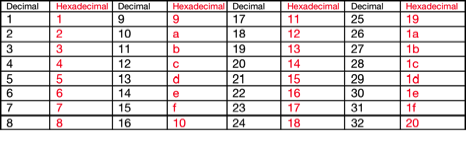
A hexadecimal is a numbering system that counts to 16. Whilst the decimal system counts from 1 to 10 before it resets (e.g. 1–10, 11–20, 21-30, 211-220), a hexadecimal system counts from 1 to 16 before resetting. However, since it is not possible to show more than 10 numbers before resetting (i.e. not possible due to the fact that the decimal system is used to portray hexadecimals), letters are used to fill the remaining 6 numbers before the integer ends. Thus, the last integer in a hexadecimal before the number resets ends with 0 (e.g. f à 10, 4f à 50), just as how it would in the decimal system (e.g. 9 à 10, 49 à 50). This table shows how hexadecimals are written up to the decimal number 32:

A simplified way of describing the decimal system is by calling it a base-10 system, which means that it contains 10 digits. The hexadecimal system on the other hand is a base-16 system, containing 16 digits.

But what use does it have if we are following and accustomed to the decimal system? Well, it is mainly used as a convenience for large numbers. For instance, instead of writing ‘255’ in the decimal system, you could write ‘FF’ in hexadecimal format (FF = 15x16 + 15). This is commonly used in computer codes (e.g. color map, memory addresses, HTML, etc).

In short: A hexadecimal is a numbering system that uses 16 digits as opposed to the decimal system (10 digits) that we are accustomed to today. This system is meant to make large numbers more convenient to read and implement, especially in computers.

If you have any questions or doubts, or would like to contribute, then please do not hesitate to leave a comment!

Monday, August 29, 2011

Question of the week 32: Fugitive

Hi and welcome to this week’s question of the week! This week, the word ‘fugitive’ will be covered in the following question:

How do fugitives get caught?

A fugitive is a person that is on the run from the government or the police, with the purpose of avoiding arrest. Individuals who have committed crimes such as corruption, drug dealing, and murder are most likely to become fugitives due to the severity of the crime and consequent penalty. Since individuals become fugitives when authorities cannot find them, various methods are required to find them. Here are five ways in which policemen can track down and catch fugitives:

  • Use the location of bank transactions to trace the fugitive
  • Use bounties (reward for capture) to encourage people to help find the fugitive
  • Use family members to convince the fugitive to turn him/herself in
  • Authorities collaborating with each other across regions/countries to share information on the fugitive
  • Trace phone calls made by the fugitive

In short: A fugitive is a person that is on the run from the government or the police. Catching a fugitive may not be easy, but there are a number of methods to catch them. These include tracing bank transactions, bounties, using family members, having authorities collaborate, and tracing phone calls.

If you have any questions, doubts, or would like to contribute, then please do not hesitate to leave a comment!

Monday, August 22, 2011

Question of the week 31: Regime

Hi and welcome to this week’s question of the week! This week the word ‘regime’ will be covered in the following question:

Why do political regimes falter?

A political regime is a government that puts rules, regulations, norms, and laws for citizens of a country to abide. It is either elected through a country’s citizens, through force, or through a governmental procedure.

Here are some reasons why political regimes falter:

1) Citizen rebellion – When a government does not provide what its citizens want and maintains its power, riots or rebellions may occur. This is especially prevalent in countries with an autocratic regime. Violent behavior would then force the political regime to leave.

2) Pressure from other countries – When a political regime does not respect human rights, other countries and organizations may put pressure on that regime to either change their ways of running a country or risk facing a trade embargo or even a conflict. One example is the spread of Communism which capitalism tried to contain in the Vietnam War.

3) Government not keeping its promises – When a president or prime minister is elected, that individual will put in place his or her political regime. This includes a set of goals and promises that were said during the political campaign before election. However, when a government cannot meet its promises, the leader’s trust, reputation, and popularity begins to falter, thereby leading to new elections.

4) Corruption, bribery, or other legal issues – Sometimes the leader of a country has a personal agenda that is not to the interest of a country. Corruption and bribery not only wastes taxpayer money for personal gain, it also limits government investments in improving the country’s standards of living. A result of this would be that the leader does not get re-elected, gets impeached, or that the reputation of the whole political party would be lost.

In short: A political regime is the rules, regulations, norms, and laws that are set by a government. They can fail if there is a citizen uprising, if there is pressure from other countries to stop the regime, if the regime does not meet its expectations, or if legal issues plague the regime leader.

If you have any questions, then please do not hesitate to leave a comment!

Monday, August 15, 2011

Question of the week 30: Riots

Hi and welcome to this week’s ‘Question of the Week’! I hope that everybody has had or is having a nice summer vacation! However, as is with every holiday, it comes to an end. Nevertheless, the question of the week is back. This week, the word ‘Riot’ will be covered in the following question:

Do riots create more change than peaceful demonstrations and protests?

The term riot stands for a violent public uprising, where a group of people create civil unrest. Examples include, the riots that occurred in London that started from a peaceful protest against the police for shooting and killing a person, and the riots that broke out in the Middle-East to topple the dictatorial/autocratic regimes.

Demonstrations, protests, and riots all have a common goal, to create change. How they achieve these changes however are different. Both demonstrations and protests can be done peacefully. For instance, a group of people that protest against the country’s involvement in war can show this through creating signs and showing negative pictures in the hope that it would persuade decision makers to back out from the war. If the protest gains supporters over time, it would then force the government to make changes.

A riot on the other hand involves violent behavior in order to intimidate decision makers into making changes. This type of behavior has, for instance, led the Syrian leader Bashar al-Assad to create changes in the Syrian parliament and give in to some demands to retain peace in the country. Riots however do not have to create positive changes for the rioters. As is evident in the London riots, changes have been made by the British police force in how decision-making is done during such situations. All that the rioters gained from their actions were court appearances and penalties.

To say that riots create more change than peaceful demonstrations and protests is incorrect as both create them. However, riots have a more dramatic way in showing social frustration and thus leads to quicker changes. This usually comes at the expense of the rioters themselves as they end up doing more harm than good.

In short: Riots are violent public uprisings where people try to create change through wrecking havoc. Whilst riots may create change faster, it does not mean that it will create a positive change for them. Demonstrations and protests on the other hand are more peaceful, and allow other people to understand the changes. Through this way, it forces the government and/or decision makers to create changes since their reputation and popularity is put at stake.

If you have any questions, doubts, or would like to contribute, then please do not hesitate to leave a comment!

Sunday, July 10, 2011

Question of the week 29: Vociferous

Hi and welcome to this week’s question of the week! This week, the word ‘vociferous’ will be covered in the following question:

Name five man-made vociferous sounds

The term vociferous stands for something that is noisy or loud. For instance, a vociferous baby on an airplane was crying for her milk. Animals such as lions and bears become vociferous when threatened. Vociferous can also describe the noise of an explosion.

Here is a list of five man-made vociferous sounds:

1. Race cars – Race days such as F1, GP2, MotoGP, Nascar, and FIA GT, just to name a few, create a lot of sound pollution that affect nearby residential areas. As such, some circuits have a limited number of race days per year to minimize it.

2. Airplanes – Due to the sound pollution created by airplane engines, in some cities/countries airports are closed during the night.

3. Vuvuzela – A trumpet that has its history in South Africa. It was extensively used during the 2010 FIFA World Cup by fans supporting their countries. For the players and some spectators it was however also a nuisance.

4. Rock concerts – Music bands play loud music to involve the crowd and let them feel the full rhythm and beats of the songs. This however usually comes with a side effect, where it seems as if a bubble is covering your ears.

5. Alarms – Unlike the above-mentioned vociferous sounds, alarms are purposefully loud. They are meant to warn people of an emergency.

In short: The word vociferous stands for something or somebody being loud or noisy. This includes a baby crying on an airplane, or a car making a screeching sound after hitting the brakes very hard. Five man-made vociferous sounds include race cars, airplanes, vuvuzelas from the world cup, rock concerts, and alarms.

If you have any questions, suggestions, or examples, then please do not hesitate to leave a comment!

Sunday, July 3, 2011

Question of the week 28: Omnipresent

Hi and welcome to this week’s question of the week! For this week, the word ‘omnipresent’ will be covered in the following question:

Which mode of transportation carries the lowest omnipresent risk of fatality?

The term omnipresent stands for a danger or problem that is present at all times, such as a disaster that can occur at any time, a prison where criminals fighting each other is omnipresent, or the noise pollution from living close to an airport.

The modes of transportation are air, land, and water. For simplicity purposes, air transport will cover airplane travel, land transport will cover travel via cars and trains, and water transport will cover boat travel. The following list shows the number of fatalities per billion km, journeys, or hours traveled for each of the 4 forms of transportation mentioned:

Fatalities per billion KM

Fatalities per billion journeys

Fatalities per billion hours

Airplanes

0.05

117

30.8

Cars

3.1

40

130

Boats

2.6

90

50

Trains

0.6

20

30

(source: http://www.numberwatch.co.uk/risks_of_travel.htm, originally from an article by Roger Ford)

Depending on how one looks at the statistics, airplane travel can carry the lowest omnipresent risk of injury. 0.05 people are killed due to an airplane accident over a span of one billion kilometers. However, when looking at it from the number of journeys and number of hours perspective, trains carry the lowest omnipresent risk.

It must be noted that whilst the media portrays the fact that airplane travel is the safest mode of transportation, it is really difficult to find factual and statistical information on this as it is not public knowledge. As such, the data used in this article represents what was attainable at the time of writing this article.

In short: Omnipresent stands for a danger or problem that is present at all times. Examples include the risk of a flat tyre, or the risk of a natural disaster, as both could happen anytime. Depending on how one interprets data, airplanes and trains can be seen as having the least omnipresent risk of fatality.

If you have any other thoughts or ideas, then please do not hesitate to leave a comment!